
TACTILE ACOUSTIC PHYSICS
The Physics Behind Controlled Tactile Bass.
SoundKeel converts low-frequency audio into controlled linear kinetic energy, allowing seating and furniture structures to reproduce tactile bass with speed, precision and low mechanical noise.
True waveform fidelity: low-frequency audio reproduced as physical thrust.
SECTION 01 / HARDWARE ARCHITECTURE
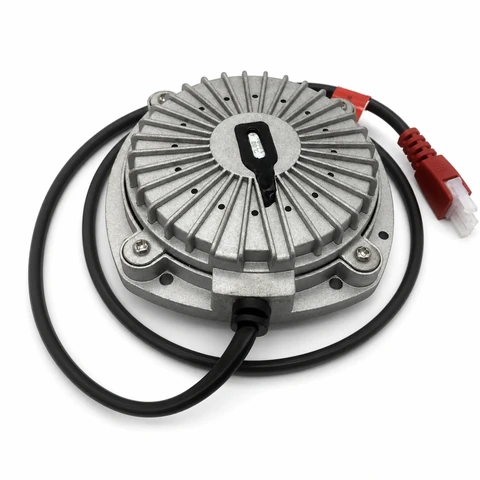
Inside the Core Shaker.
Engineered for continuous high-amplitude excursion, transient response, and thermal endurance.
01 / Die-Cast Aluminum Shell
High-pressure aluminum alloy housing engineered to act as an integrated passive heatsink, supporting thermal stability during sustained operation.
02 / High-Temperature Voice Coil
Voice-coil construction designed for demanding transient loads and dynamic power changes.
03 / High-Flux Magnetic Motor
Optimized magnetic circuit engineered for clean physical impulse response.
04 / Dual-Suspension Centering Spider
Fatigue-resistant centering structure designed to support linear mechanical travel.
SECTION 02 / BENCHMARK COMPARISON
Acoustic Transducer vs. Conventional ERM Vibration Motor
| Performance Dimension | SoundKeel Core Shaker (Voice-Coil) | Conventional ERM Motor |
|---|---|---|
| Operating Principle | ✓ Dynamic voice coil in magnetic gap | — Eccentric rotating mass on DC shaft |
| Frequency Range | ✓ 20–150 Hz | — Fixed 50–60 Hz |
| Response Latency | ✓ Low-latency audio-signal response | — Rotational start/stop lag |
| Acoustic Noise | ✓ Direct kinetic transmission | — Audible motor hum and higher-frequency buzzing |
| Seating Experience | ✓ Localized tactile feedback | — Rotational massage-style vibration |
SECTION 03 / SYSTEM ARCHITECTURE
Typical System Integration Guidelines
Recommended practices for electrical and mechanical engineers to achieve efficient energy transfer.
Low-Pass Filtering (LPF)
80 Hz – 120 Hz RangeFilters mid-range content so the transducer focuses on low-frequency tactile output.
Class-D Sub Amplification
25 W – 50 W per UnitTypical efficient amplifier range for project electrical design.
Frame-Level Decoupling
Elastomeric GasketsSeparates thin-panel resonance paths while coupling force into a load-bearing frame.