
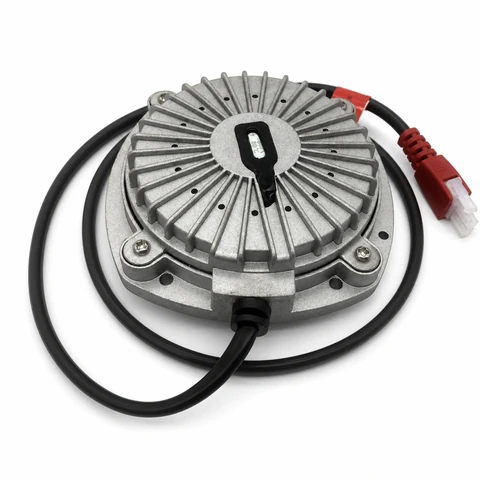

A tactile transducer is an electromechanical device that converts an electrical signal—typically low-frequency audio—into mechanical vibration that can be felt through a solid structure.
Instead of relying primarily on air movement to reproduce bass, a tactile transducer transfers energy into a chair, sofa, simulator frame, platform or other structure that is in contact with the user.
The result is a physical layer of audio: an explosion can create an impact through a theater seat, an engine can be felt through a racing simulator, and low-frequency effects can travel through a recliner without requiring the entire room to become louder.
In audio and seating applications, tactile transducers are also commonly called bass shakers. Manufacturers including Dayton Audio and ButtKicker use the terms tactile transducer, bass shaker and haptic transducer for products designed around this type of low-frequency physical feedback.
The simplest way to understand the difference is:
A loudspeaker primarily moves air. A tactile transducer primarily moves structure.
But the transducer itself is only part of the system. What the user actually feels depends on the complete path between the electrical signal and the body.
What Does a Tactile Transducer Do?
A tactile transducer adds physical sensation to audio or control information.
Imagine a home theater scene with a deep explosion. A conventional loudspeaker or subwoofer generates acoustic energy that travels through the air to your ears and body.
A tactile transducer can use the low-frequency portion of that signal to create mechanical movement directly in the seat.
Instead of only hearing the event, you can also feel it.
The same principle can be used for:
- engine vibration in a racing simulator,
- road or curb effects,
- impacts in games,
- cinematic low-frequency effects,
- music-related bass feedback,
- tactile feedback integrated into furniture.
Commercial tactile systems are commonly used with chairs, sofas, gaming systems and home-theater installations, and some systems can operate effectively alongside headphones where high room sound levels are undesirable.
The purpose is not simply to make an object shake.
A good tactile system should make the physical sensation feel connected to the content.
How Does a Tactile Transducer Work?
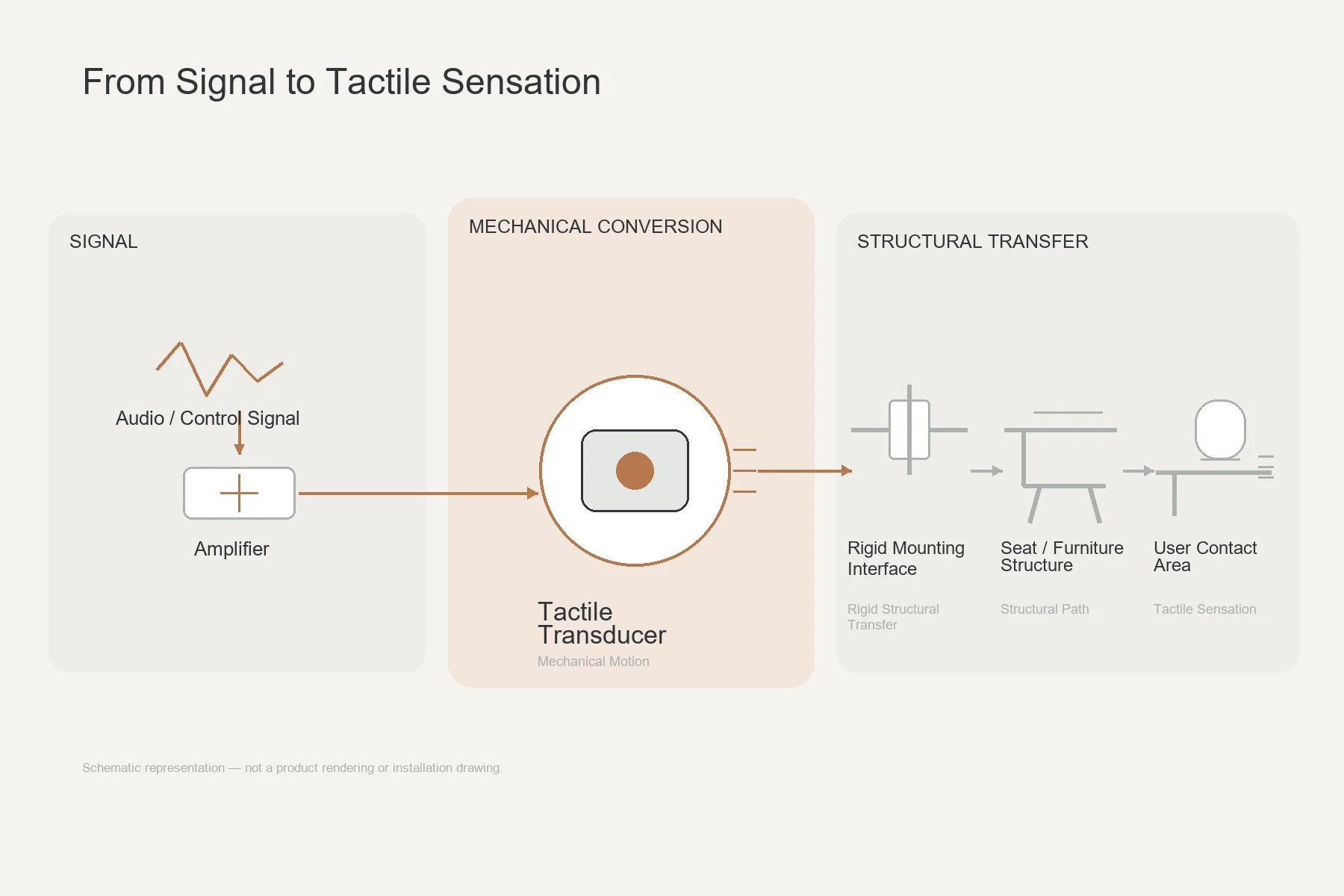
A basic tactile audio system can be represented as:
Audio or control signal → Amplifier → Tactile transducer → Mounting interface → Structure → User
Each part affects the final result.
1. A low-frequency signal enters the system
The signal may come from an AV receiver, computer, DSP, game system, simulator software or another source.
For audio-driven systems, low-frequency content is normally the most useful because tactile transducers are intended primarily to reproduce physical bass information rather than full-range sound.
Depending on the system, low-pass filtering or DSP may be used to control which frequencies reach the tactile channel.
2. An amplifier drives the transducer
A tactile transducer needs electrical power in much the same way that a loudspeaker does.
The amplifier therefore needs to be suitable for the transducer’s:
- impedance,
- power requirements,
- number of connected transducers,
- intended operating range.
For multiple units, series and parallel wiring can change the load presented to the amplifier, which is why amplifier compatibility must be checked rather than selecting an amplifier from wattage alone.
3. Electrical energy becomes mechanical motion
In many electromagnetic tactile transducers, a magnetic motor, voice-coil system and moving mass create reciprocating mechanical force.
As the electrical signal changes, the moving assembly accelerates accordingly.
Unlike a conventional loudspeaker, that mechanical energy is not primarily used to drive a cone and generate sound pressure.
It is transferred into the structure attached to the transducer.
Different tactile transducer designs use different mechanical architectures, so the internal construction should not be assumed to be identical across every product.
4. The structure transfers that motion to the user
This final step is critical.
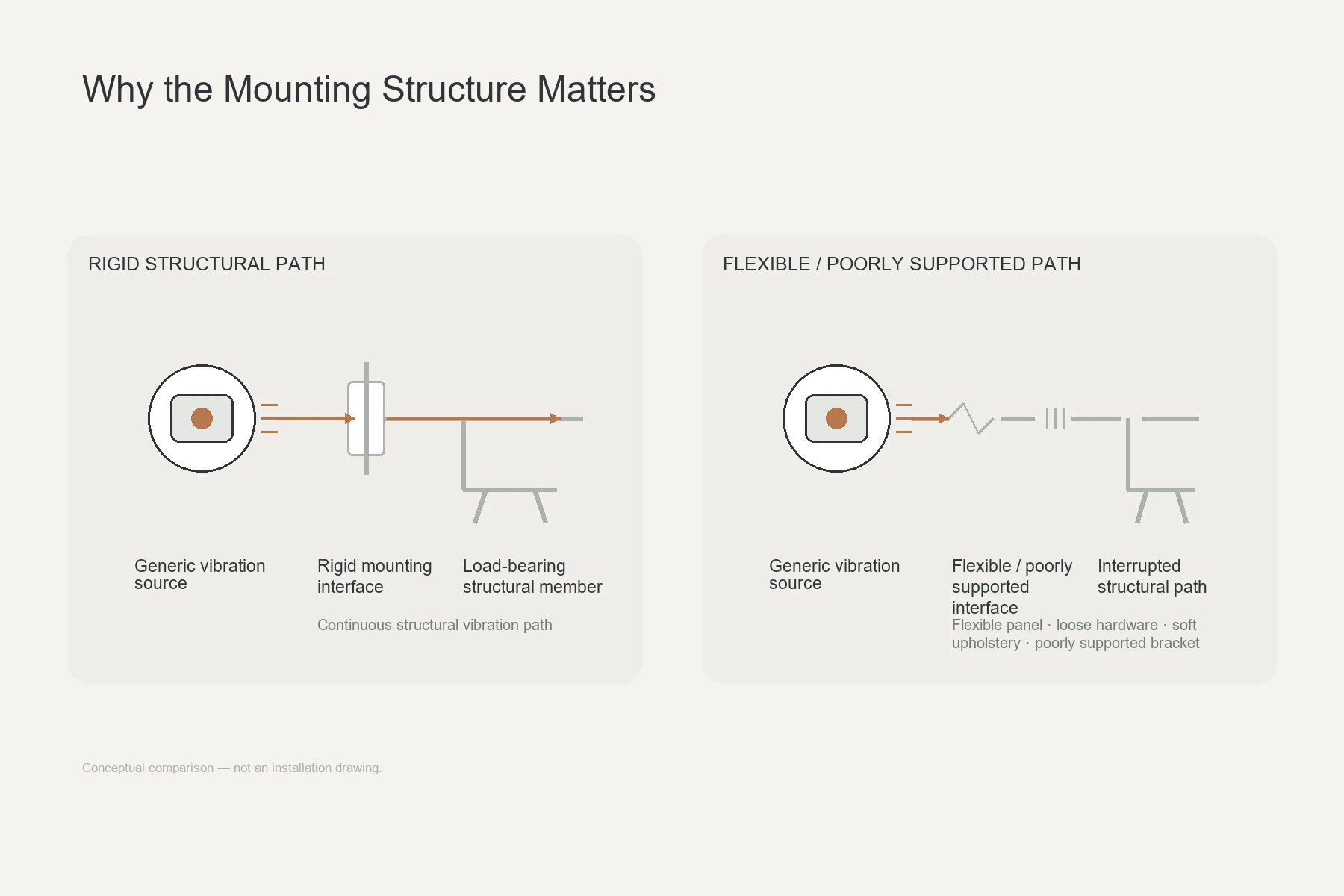
A transducer mounted to a rigid structural member can behave very differently from the same unit attached to:
- a flexible panel,
- loose hardware,
- soft upholstery,
- a poorly supported bracket.
The structure effectively becomes part of the tactile system.
That is why tactile performance cannot be evaluated from the transducer specification sheet alone.
Why the Mounting Structure Matters
This is one of the most important principles in tactile audio integration.
A tactile transducer generates mechanical force.
The mounting system determines where that force goes.
If there is looseness between the transducer, bracket and frame, part of the movement can become unwanted mechanical motion or noise instead of useful tactile energy.
If the mounting point is highly flexible, some of the energy can be absorbed locally rather than transferred effectively through the seating structure.
And if the transducer is installed on a decorative panel rather than a load-bearing structure, the panel itself may buzz or resonate.
Manufacturers of commercial tactile systems likewise emphasize the influence of the driven surface or platform on total system response, and provide dedicated mounting solutions for furniture, chairs and simulator structures.
A useful way to think about the system is:
Transducer output ≠ user experience
Instead:
Transducer + mounting interface + structure = tactile system
For furniture and seating integration, tactile integration is partly an audio problem and partly a mechanical-engineering problem.
The mounting location should therefore be considered during the structure-design stage whenever possible.
Is a Tactile Transducer the Same as a Bass Shaker?
In home theater, gaming and simulation, the terms are often used interchangeably.
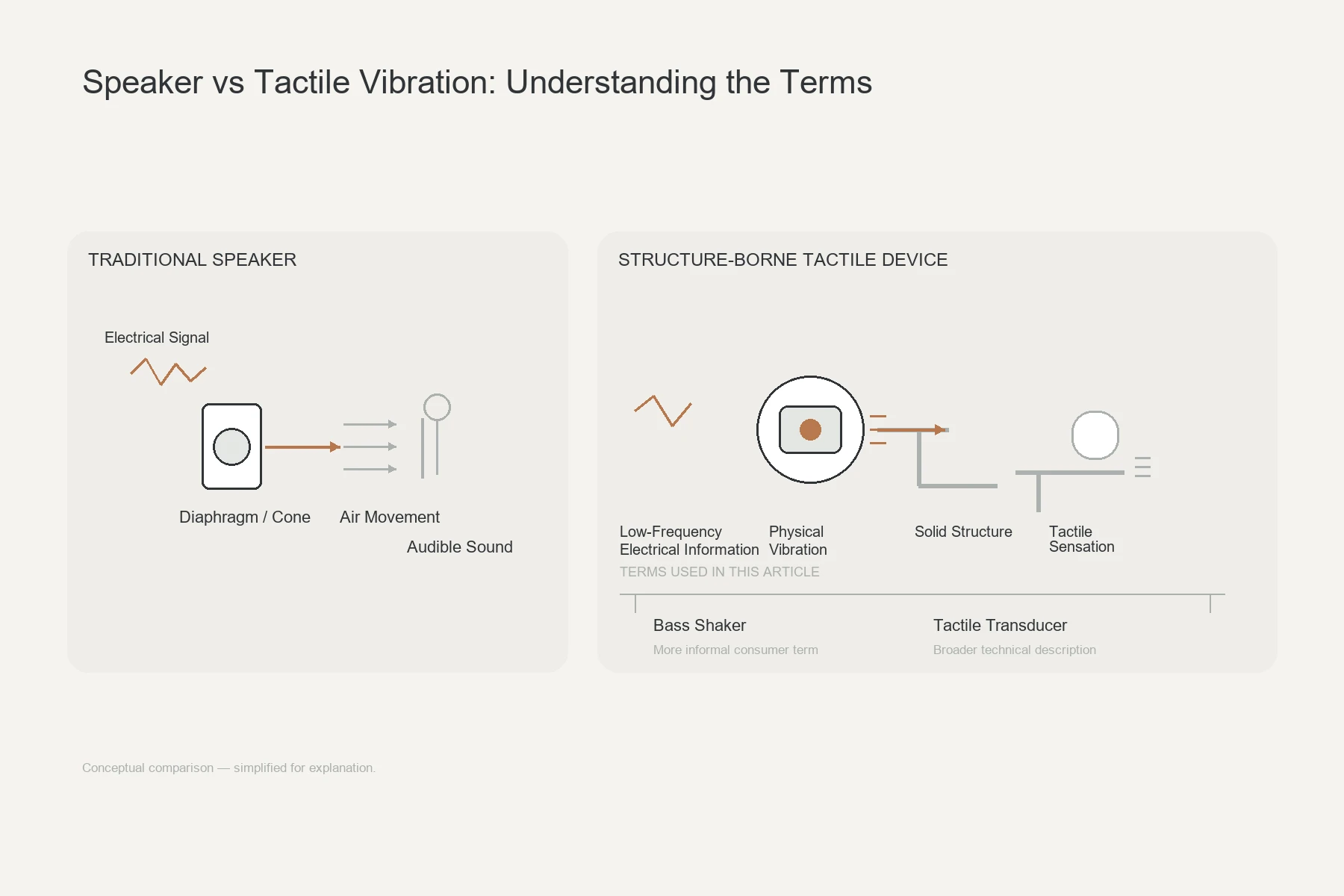
Bass shaker is the more informal consumer term.
Tactile transducer is a broader technical description.
Both usually refer to an electromechanical device that converts low-frequency electrical information into physical vibration transmitted through a structure.
However, a tactile transducer should not automatically be treated as equivalent to every type of vibration device.
For example, a simple eccentric rotating mass motor produces vibration by spinning an unbalanced mass. It is useful for alerts and basic haptic feedback, but its operating principle and control behavior differ from an audio-frequency tactile transducer.
For immersive audio applications, the goal is not merely:
Create vibration.
The goal is:
Reproduce changing low-frequency information as controlled physical motion.
Tactile Transducer vs. Traditional Speaker
Traditional loudspeakers and tactile transducers can both convert electrical signals into mechanical movement, but the useful output is directed differently.
Traditional loudspeaker
A loudspeaker drives a diaphragm or cone.
The cone moves air.
The resulting changes in air pressure become audible sound.
Tactile transducer
A tactile transducer couples mechanical force into a solid structure.
The structure moves.
The user experiences part of that movement through physical contact.
This is why a tactile transducer should not simply be viewed as a replacement for a loudspeaker or subwoofer.
The technologies can work together.
For example:
Home theater
Speakers + subwoofer
→ acoustic experience
Tactile transducer integrated into seating
→ localized physical experience
Together
→ audible + tactile low-frequency reproduction
Some commercial systems are specifically marketed for providing tactile response without requiring the same sound-pressure output from a subwoofer, including use with headphones.
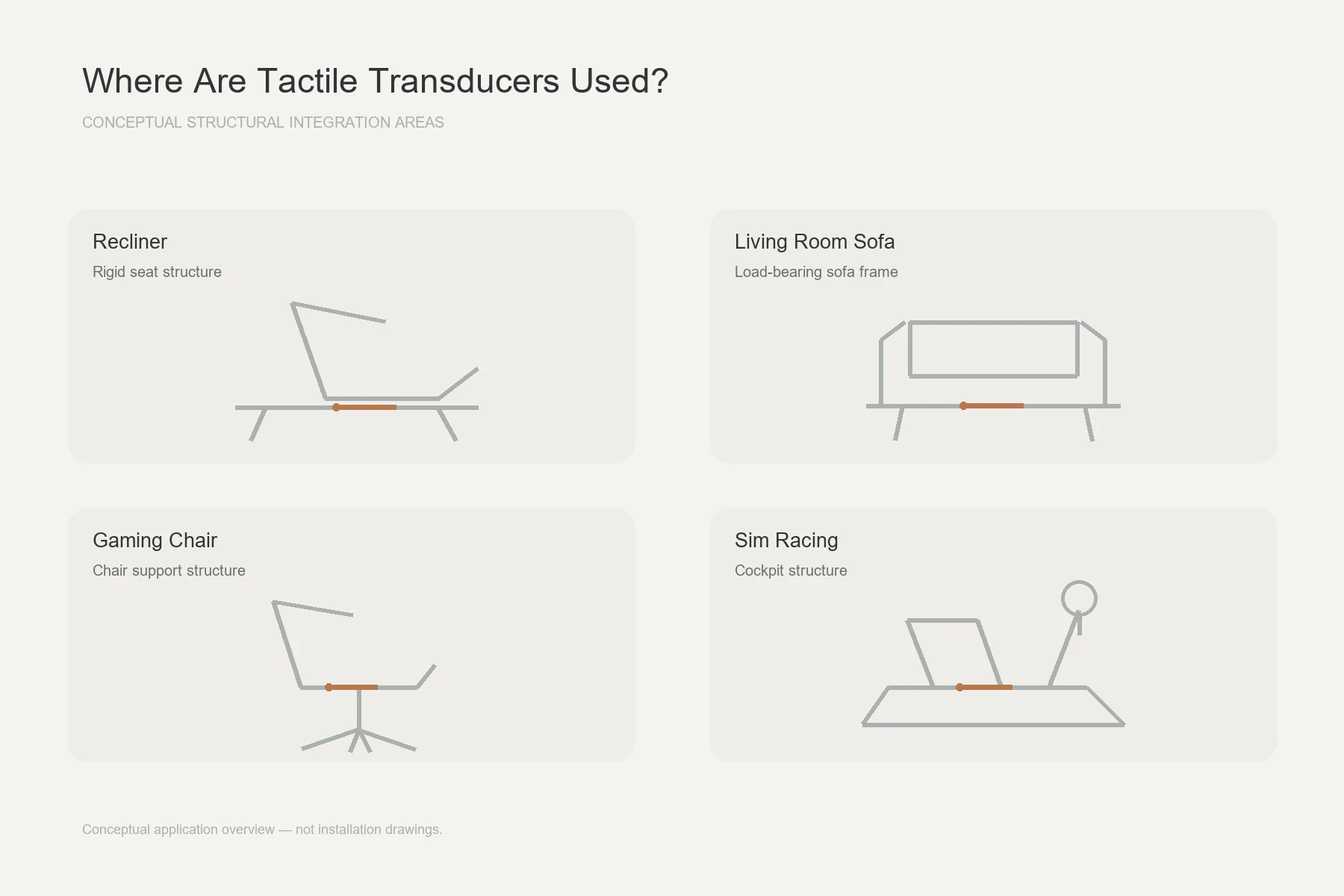
Where Are Tactile Transducers Used?
The basic principle can be applied anywhere the user is physically connected to a structure.
Home Theater Seating
Home theater is one of the most established tactile-audio applications.
A tactile transducer can be mechanically coupled to a theater chair, recliner or seating platform so low-frequency effects are transferred through the structure.
Explosions, impacts, engines and deep cinematic effects can therefore be felt locally at the seat.
The objective should not be uncontrolled furniture vibration.
A properly integrated system should make the tactile response feel synchronized with the content.
Recliners and Motion Furniture
Tactile feedback can also be integrated into:
- recliners,
- motion sofas,
- cinema seating,
- smart furniture.
For product manufacturers, installation should ideally be considered before the finished upholstery stage.
Important questions include:
- Where is the rigid structure?
- Is there sufficient mounting area?
- How does vibration travel through the frame?
- Is there enough clearance around the transducer?
- How will wiring be routed?
- Can the component still be serviced after assembly?
These considerations become especially important when a prototype needs to become a repeatable production design.
Sim Racing Rigs
Tactile transducers are widely used in simulation systems.
Depending on how the system is controlled, feedback can represent effects such as:
- engine behavior,
- gear shifts,
- road surface,
- curb strikes,
- impacts,
- wheel slip or other vehicle events.
Some modern sim-racing tactile systems can operate from game audio, while others use telemetry software to generate individual haptic effects.
Rigid aluminum-profile chassis are particularly interesting from an integration perspective because transducer location, mounting brackets and structural paths can be deliberately engineered.
Gaming and Ergonomic Chairs
Gaming chairs can use tactile feedback to add a physical dimension to interactive content.
Compared with a large simulator chassis, however, chair structures may offer:
- less mounting space,
- thinner structural members,
- moving mechanisms,
- a gas-lift structure,
- flexible upholstery.
The challenge is therefore not just finding a transducer that fits.
The mounting system also needs to transfer useful mechanical energy without interfering with normal chair movement or creating unwanted mechanical noise.
OEM Seating and Furniture
For an OEM product, the tactile transducer should ideally be considered as part of a complete system rather than an accessory added at the end.
That system may include:
Signal architecture
↓
Amplifier and filtering
↓
Tactile transducer
↓
Mechanical mounting interface
↓
Seat or furniture structure
↓
User contact area
The earlier these relationships are considered during development, the easier it becomes to design mounting geometry, wiring, assembly access and repeatable production processes around them.
What Affects Tactile Performance?
There is no single specification that predicts the complete tactile experience.
Several factors work together.
Frequency content
Different low-frequency regions can produce different physical sensations.
The correct operating range depends on the transducer, application and desired effect.
Amplifier matching
The amplifier needs to operate safely with the electrical load while providing suitable output for the intended transducer.
Mounting rigidity
A secure mounting interface helps control the transfer of mechanical force.
Structural path
The energy needs an effective route from the transducer through the product and toward the user’s contact area.
Structural mass and stiffness
A small rigid chair, a heavy sofa and an aluminum simulator chassis do not respond identically to the same mechanical input.
The driven structure therefore contributes directly to the final system response.
This is why simply choosing a transducer with a larger wattage rating does not guarantee better tactile performance.
What Should You Check Before Choosing a Tactile Transducer?
When comparing tactile transducers, start with the complete application.
Useful parameters include:
- rated power,
- maximum power,
- nominal impedance,
- physical dimensions,
- mounting pattern,
- operating or frequency range,
- mechanical clearance,
- lead or connector design,
- mounting structure,
- amplifier compatibility.
But specifications should be evaluated in context.
A compact transducer integrated into a chair has different requirements from a high-output unit driving a large platform.
Likewise, an OEM seating program introduces considerations that may not matter in a single DIY installation, including:
- assembly repeatability,
- dimensional tolerance,
- wiring architecture,
- serviceability,
- manufacturing process,
- packaging and supply.
The correct transducer is therefore not necessarily the one with the largest headline number.
It is the one that fits the electrical and mechanical requirements of the system.
Does a Tactile Transducer Make Sound?
A tactile transducer can produce some audible mechanical output.
It should not be described as completely silent.
Its primary purpose, however, is to transfer mechanical vibration into a structure rather than reproduce sound through the air like a conventional loudspeaker.
Commercial tactile products are often specifically designed for strong physical response with comparatively limited acoustic output.
If an installation produces excessive:
- rattling,
- buzzing,
- hardware noise,
- panel resonance,
the source may be the mounting structure rather than the intended tactile output.
Checking fasteners, brackets, interfaces and surrounding panels is therefore an important part of troubleshooting.
Do You Need a Tactile Transducer?
A tactile transducer is useful when physical low-frequency feedback adds meaningful information or immersion to an experience.
That might mean:
- feeling cinematic effects through a theater recliner,
- reproducing vehicle behavior through a racing simulator,
- adding tactile feedback to a gaming chair,
- integrating physical audio into a furniture product.
The key question is not simply:
How much vibration can the transducer produce?
A more useful engineering question is:
How can the tactile energy be transferred through the structure in a controlled and repeatable way?
That question connects the transducer, amplifier, mounting interface and host structure into one system.
Frequently Asked Questions
What is a tactile transducer used for?
A tactile transducer converts electrical signals, typically low-frequency audio, into mechanical vibration that can be felt through structures such as chairs, sofas, simulator rigs and platforms.
Is a tactile transducer the same as a bass shaker?
In home theater, gaming and simulation applications, the terms are commonly used interchangeably. “Bass shaker” is usually the more informal term, while “tactile transducer” is the broader technical description.
Does a tactile transducer make sound?
Some audible mechanical output is possible, but producing sound through the air is not its primary function. Its useful output is mainly transferred mechanically into the structure on which it is installed.
Does a tactile transducer need an amplifier?
Most passive audio tactile transducers require an amplifier. The amplifier should be selected according to the transducer’s impedance, power requirements and system configuration.
Can a tactile transducer be installed in furniture?
Yes. Tactile transducers are commonly used with chairs, sofas and home-theater seating. For integrated furniture products, rigid mounting locations, structural transmission, wiring, clearance and serviceability should be considered during design.
Where should a tactile transducer be mounted?
A useful mounting point is typically a structurally rigid part of the product that can transfer mechanical energy toward the user’s contact area. The ideal location depends on the product structure, transducer and desired tactile behavior.
Explore Tactile Audio Integration
Tactile performance depends on more than the transducer alone.
Explore how SoundKeel approaches low-frequency tactile technology, structural integration and seating applications:
- Explore Tactile Transducer Technology →
- View tactile audio applications →
- View the Core Shaker →
- Discuss an OEM Integration Project →