
A powerful subwoofer can make a movie soundtrack feel physical.
A tactile transducer takes a different approach.
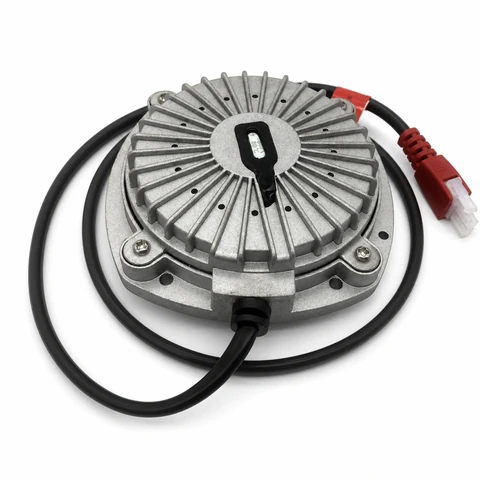
Instead of relying only on sound pressure in the room, it transfers low-frequency mechanical energy directly into the seat.
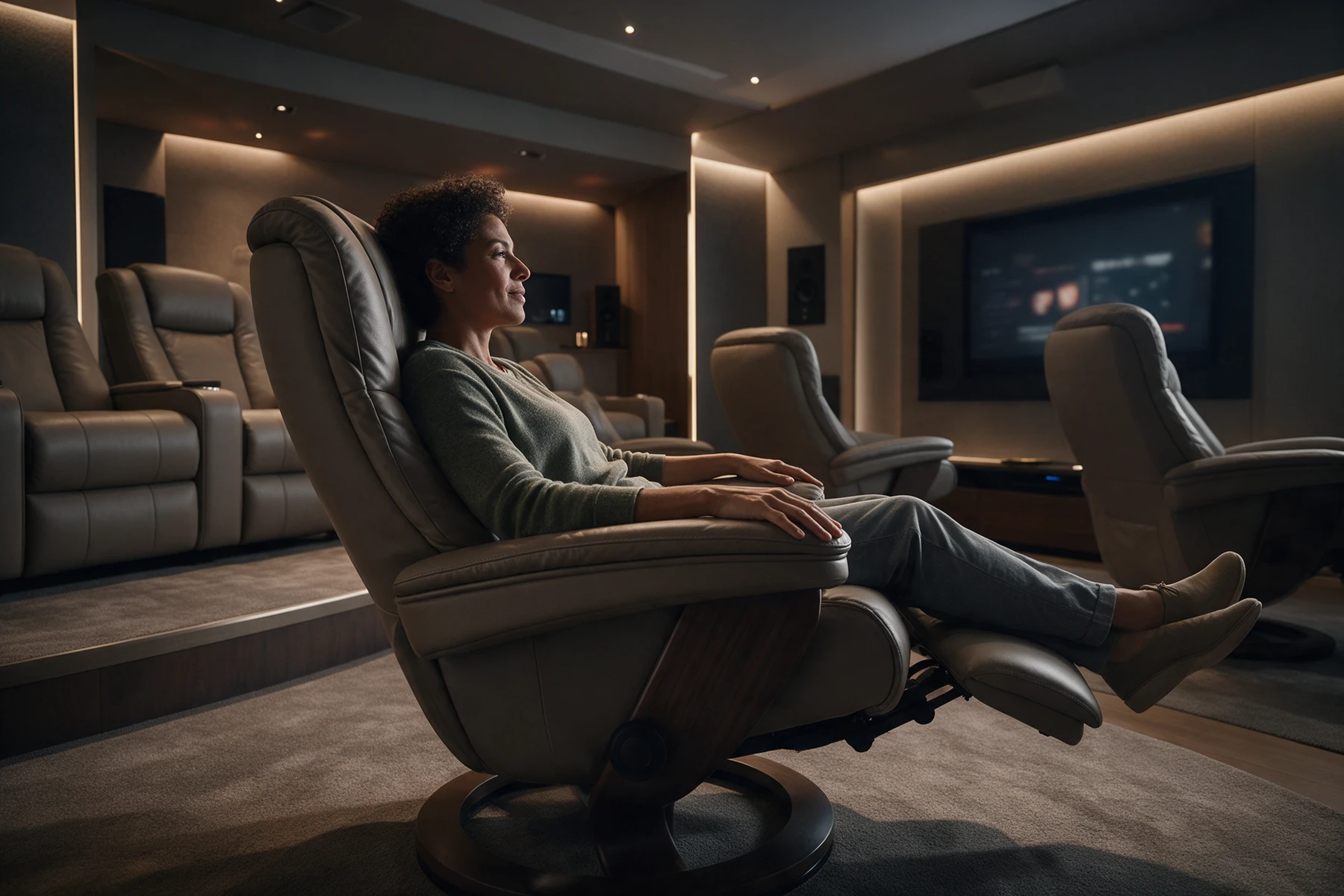
That means an explosion, engine, impact or deep bass event can be felt through the recliner or theater chair at the same time it is heard through the audio system.
This physical layer is often called tactile audio or bass-shaker feedback.
It does not need to replace the subwoofer.
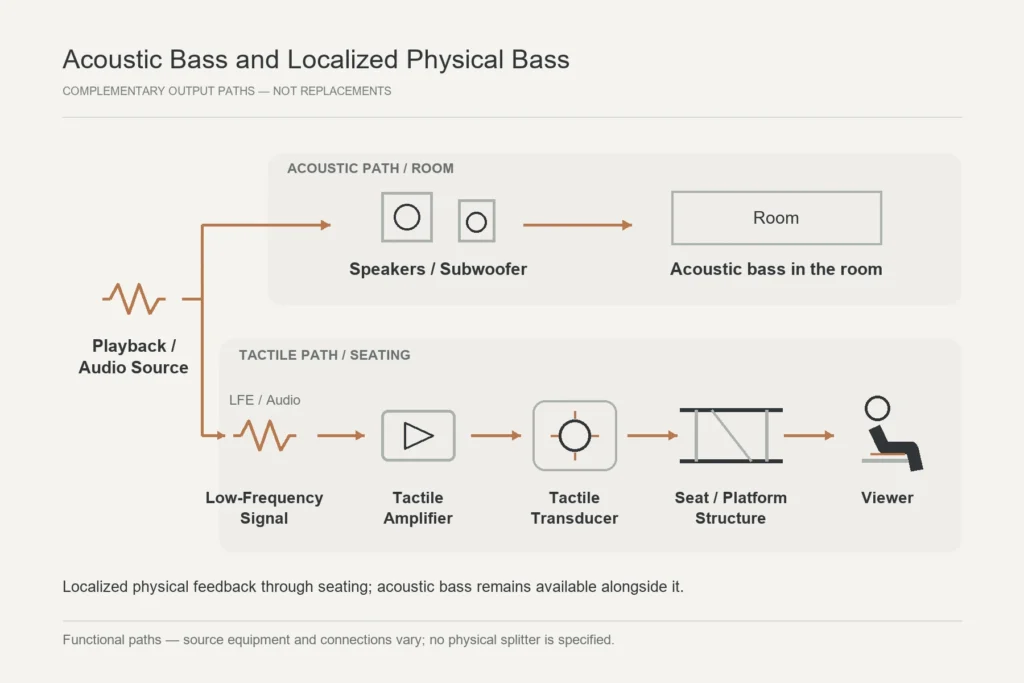
In a well-designed theater, the two systems can complement each other:
Speakers and subwoofers → acoustic bass
Tactile transducers → localized physical bass
What Does Tactile Audio Add to a Home Theater?
Traditional low-frequency reproduction fills the room with acoustic energy.
Tactile feedback concentrates part of the experience at the seat.
That can make effects such as:
- explosions,
- impacts,
- engines,
- thunder,
- deep musical bass
feel more immediate.
Because the tactile energy is transferred through the seating structure, the listener can experience strong physical feedback without relying entirely on higher acoustic output in the room.
This can be especially useful when listening levels need to remain moderate.
It also gives the user an independent way to adjust physical intensity.
A Tactile Home Theater Is a Complete System
A basic system includes:
LFE / Audio Source → Low-Frequency Signal → Tactile Amplifier → Tactile Transducer → Seat or Platform Structure → Viewer
The transducer is only one part.
Poor mounting, incorrect amplifier loading or excessive high-frequency content can reduce the quality of the experience.
The best results come from treating the complete signal and mechanical path as one system.
Where Should the Transducer Be Mounted?
The transducer should be connected to a rigid structural part of the seating.
Depending on the chair, possible locations include:
- seat frame,
- structural crossmember,
- rigid seat base,
- dedicated mounting plate,
- theater platform.
The correct location is not necessarily the closest physical point to the user.
What matters is whether the structure provides an effective mechanical path into the seating surface.
A thin decorative panel may be physically close but mechanically poor.
A rigid structural member slightly farther away may perform better.
Seat Mounting vs. Platform Mounting
Home theaters generally use one of two approaches.
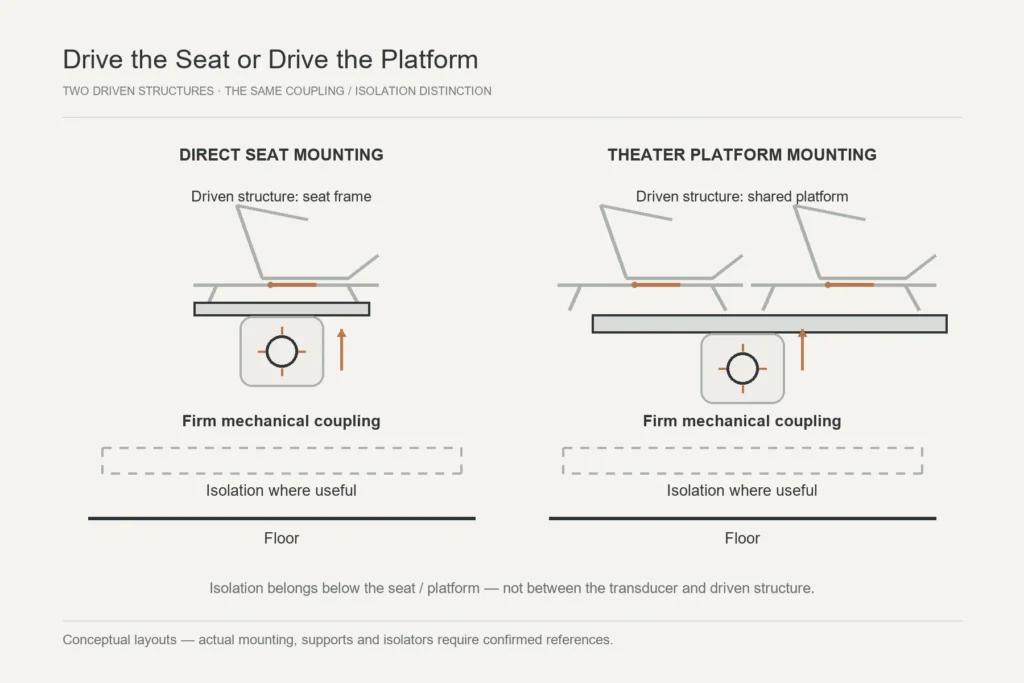
Direct Seat Mounting
The transducer is mounted directly to the recliner, chair or sofa structure.
Advantages include:
- localized tactile response,
- compact installation,
- direct mechanical connection to the seat,
- individual-seat control where desired.
This approach is especially suitable when the furniture structure provides a clear mounting zone.
Theater Platform Mounting
The transducers are installed into a platform that supports one or more seats.
This can be useful for:
- multiple-seat rows,
- shared tactile response,
- dedicated theater construction,
- systems using several transducers.
The platform itself becomes the driven structure.
Its stiffness, mass and floor isolation therefore affect the result.
How Many Tactile Transducers Do You Need?
There is no universal answer.
The correct number depends on:
- number of seats,
- seat construction,
- platform mass,
- desired intensity,
- localization,
- amplifier capability.
A single recliner may work with one appropriately integrated transducer.
A wide couch or multi-seat platform may use several.
The objective should not simply be to maximize the number of shakers.
The goal is consistent tactile feedback across the intended seating positions.
For multi-unit systems, the electrical configuration becomes important because wiring transducers in series or parallel changes the total impedance seen by the amplifier.
Choosing and Matching the Amplifier
Passive tactile transducers require suitable amplification.
Check:
- nominal impedance,
- rated power,
- number of transducers,
- wiring configuration,
- amplifier low-frequency performance,
- cooling,
- gain adjustment.
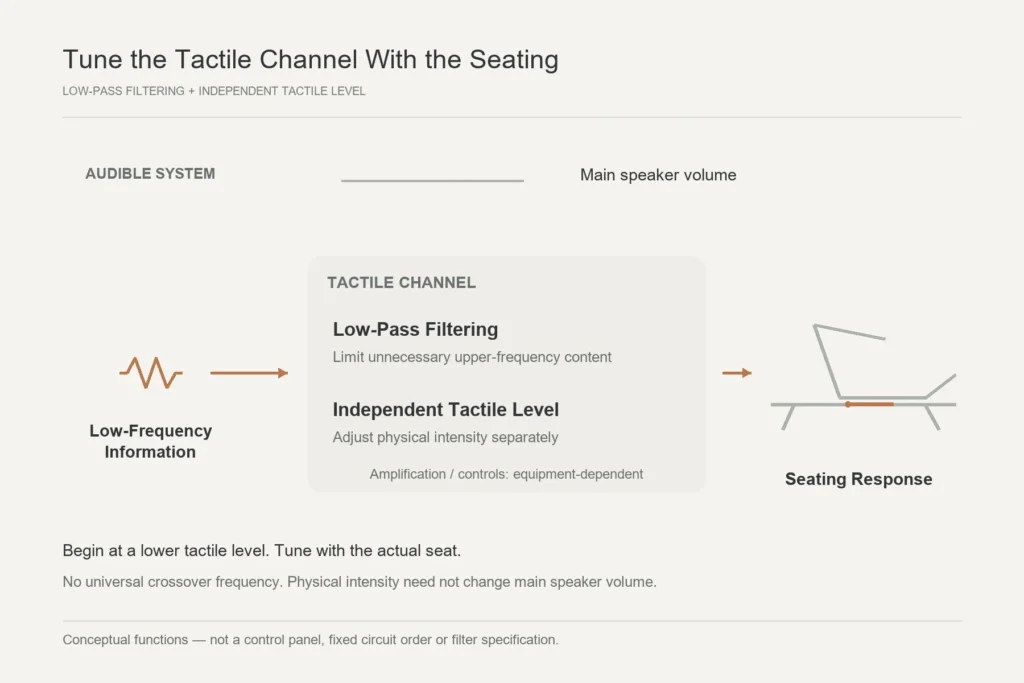
For home theater, independent tactile-level adjustment is especially useful.
It allows the viewer to change physical intensity without changing the main speaker volume.
That is often better than trying to make the tactile system track the acoustic system at one fixed ratio for every movie.
How Should the Signal Be Routed?
A home theater tactile channel normally uses low-frequency information from the playback system.
Depending on the equipment, this may come from:
- subwoofer/LFE output,
- DSP,
- dedicated tactile processor,
- amplifier with a subwoofer/tactile channel.
The exact connection architecture varies, but the principle is straightforward:
The tactile amplifier should receive the low-frequency information needed to generate the physical effects.
The main subwoofer can continue reproducing acoustic bass at the same time.
This allows the tactile and acoustic systems to work together rather than compete.
Why Low-Pass Filtering Matters
A tactile transducer is intended primarily for low-frequency physical feedback.
If too much upper-bass or midrange information reaches the seat, the result may feel unnatural.
It may also increase audible:
- buzzing,
- voices through the seat,
- mechanical resonance.
For this reason, low-pass filtering is commonly used in tactile systems.
There is no single crossover frequency that is ideal for every theater.
The final setting should be tuned with the actual seating structure.
A crossover that works well on one chair may not feel identical on another.
Mounting Must Be Rigid
A shaker can only transfer force effectively if it is mechanically connected to the structure.
Check for:
- flat contact,
- secure fasteners,
- stiff mounting plates,
- sufficient frame strength.
A loose transducer can produce:
- rattles,
- knocks,
- buzzing,
- reduced tactile output.
If the seating does not provide an appropriate mounting surface, adding a rigid bridge or plate is generally better than attaching the transducer to a weak panel.
Isolation Can Keep More Energy in the Seat
The transducer should be rigidly connected to the seating.
But the seating itself does not always need to be rigidly connected to the floor.
These are two different interfaces.
Adding suitable isolation feet beneath a chair, couch or theater platform can reduce mechanical energy leaking into the floor.
Think of it as:
Transducer → Seat: couple
Seat → Floor: isolate where useful
This often produces cleaner, more localized tactile feedback.
How Strong Should Tactile Feedback Feel?
More vibration is not always more immersive.
If the tactile system is constantly obvious, it can become distracting.
A useful setup should support the soundtrack rather than announce itself as a separate effect.
During tuning, start at a lower tactile level.
Then increase it until:
- impacts feel physical,
- deep bass gains weight,
- effects remain synchronized,
- normal dialogue does not feel distracting.
The desired level is subjective, so user adjustment is valuable.
Multi-Seat Theater Design
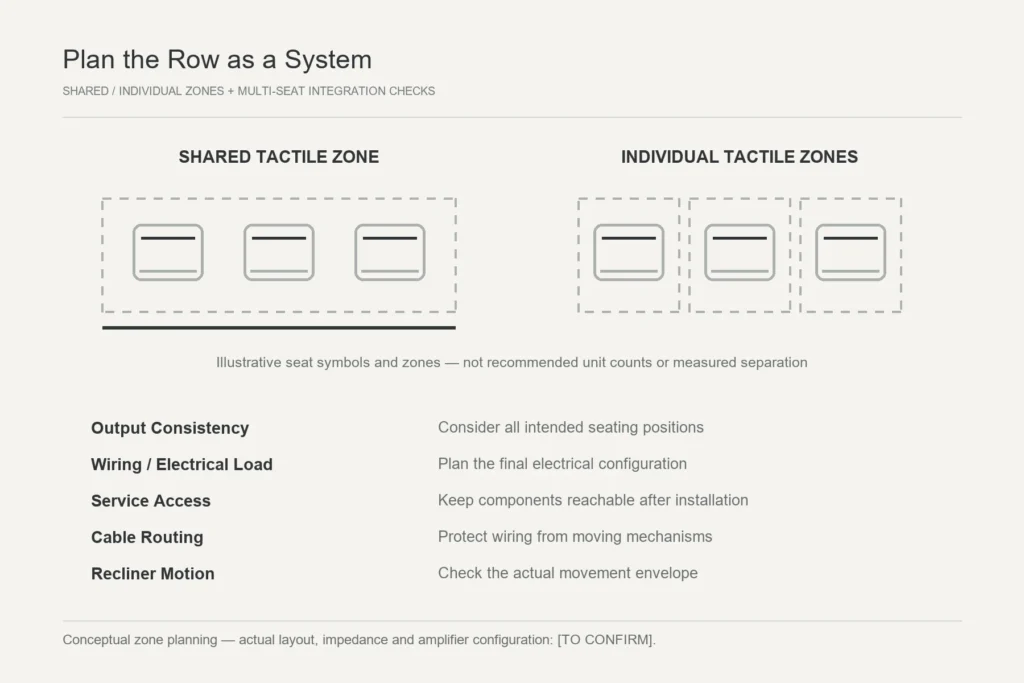
A row of theater seating introduces additional decisions.
Shared vs. individual tactile zones
A common platform can distribute mechanical energy to several seats.
Separate transducers or isolated seat structures can provide more individualized feedback.
Output consistency
The center seat and outer seats should not feel radically different unless that is intentional.
Wiring
Multiple transducers need a planned electrical configuration.
Service access
Once seats are installed against a wall or on a riser, access can become difficult.
Cable routing
Speaker-level tactile wiring should not be allowed to rub against moving recliner mechanisms.
For a permanent theater installation, these details are easier to solve during seating and platform design than after everything has been finished.
Common Home Theater Tactile Problems
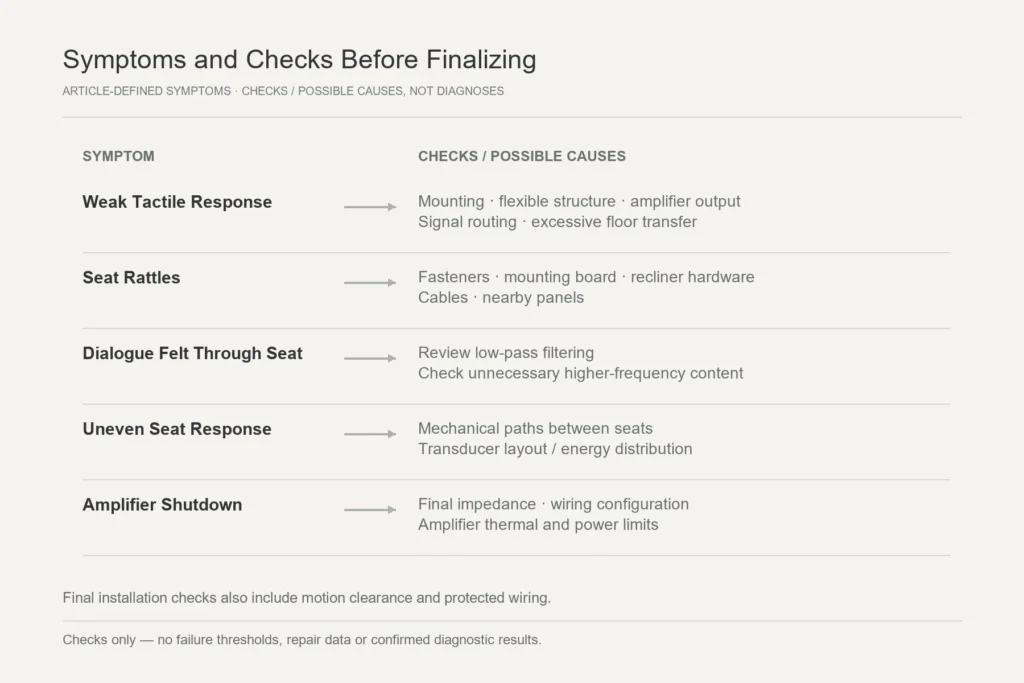
The Shaker Feels Weak
Possible causes include:
- poor mounting,
- flexible structure,
- insufficient amplifier output,
- incorrect signal routing,
- excessive energy loss into the floor.
The Seat Rattles
Check:
- fasteners,
- mounting board,
- recliner hardware,
- cables,
- nearby panels.
Dialogue Can Be Felt Through the Seat
The tactile channel may be receiving too much higher-frequency content.
Review the low-pass filtering.
One Seat Feels Stronger Than Another
The seats may have different mechanical paths, or the transducer layout may not distribute energy evenly.
The Amplifier Shuts Down
Check the final impedance and wiring configuration, as well as amplifier thermal and power limits.
Tactile Audio Is Not a Substitute for Good Bass
A tactile transducer and a subwoofer perform different jobs.
The subwoofer creates acoustic bass in the room.
The tactile system creates physical feedback through the seating.
For most dedicated theaters, they work best as complementary layers.
The tactile channel should enhance the experience—not compensate for every problem in the room’s acoustic bass system.
Home Theater Installation Checklist
Before finalizing the system, confirm:
- Is the transducer mounted to a rigid structural surface?
- Are all fasteners secure?
- Is there enough clearance for recliner motion?
- Is the wiring protected from moving hardware?
- Is the amplifier compatible with the final impedance?
- Is the tactile channel low-pass filtered appropriately?
- Can tactile intensity be adjusted?
- Are there any rattles?
- Is excessive energy entering the floor?
- Do all intended seating positions receive consistent feedback?
Frequently Asked Questions
What is a bass shaker in a home theater?
A bass shaker is a tactile transducer that converts low-frequency electrical signals into mechanical vibration that can be felt through theater seating or a platform.
Do bass shakers replace a subwoofer?
Not usually. A subwoofer creates acoustic bass, while a tactile transducer adds localized physical feedback through the seating. They can work together.
Where should I mount a bass shaker on a theater recliner?
Mount it to a rigid structural part of the recliner or to a rigid mounting plate securely connected to the frame.
Can one bass shaker work for multiple seats?
It may, depending on the shared structure, but multi-seat systems often need multiple transducers to achieve more consistent or localized feedback.
What crossover should I use for a bass shaker?
There is no universal value. Low-pass filtering is normally used, and many tactile systems operate primarily in the low-frequency region, but the best setting depends on the transducer and seating structure.
Should I isolate my theater seating from the floor?
Isolation can be beneficial when excessive mechanical energy is being transferred into the floor. Rubber feet or isolators are commonly used for this purpose.
Make Low Frequencies Physical
A home theater can reproduce sound extremely well and still benefit from another sensory layer.
Tactile transducers allow part of the low-frequency soundtrack to become physical at the seating position.
The best systems coordinate:
signal + amplifier + transducer + mounting + seating structure
rather than treating the shaker as a standalone accessory.